As a scientific field, high-energy physics is wonderfully paradoxical. To study the smallest things in existence, the largest machines ever built must generate the biggest datasets in all of science. Ultimately making sense of those whopping datasets requires researchers to develop loads of computer code.
Empowering the next generation to continue this computational endeavor is a chief goal of the Coding Camps supported by the Institute for Research and Innovation in Software for High Energy Physics (IRIS-HEP). Among IRIS-HEP’s many educational initiatives, Coding Camps are unique in that they specifically train high school teachers on software, computer programming, machine learning, and other critical enablers of modern particle physics. These teachers then bring coding into their classrooms, helping cultivate the high-energy physics and STEM workforce of the future.
“High school teachers, especially in physics and science more broadly, can have such a major influence on their students’ eventual career paths,” says Sudhir Malik, professor of physics at the University of Puerto Rico at Mayagüez and the training, education, and outreach coordinator for IRIS-HEP. “So it’s important that we start to reach students as their interest and abilities in educational attainment and understanding blossom when they’re looking ahead to college.”
Founded by the National Science Foundation (NSF) and partners in 2018, IRIS-HEP is advancing the development of software, cyberinfrastructure, and skillsets for groundbreaking physics experiments in the decades to come. Inspiring students by showing them some of the tools of the trade is critical for maintaining the pipeline of talent to fuel discovery.
“Through these Coding Camps, we want to get particle physics data and coding directly into the hands of students,” says Adam LaMee, Education Program Lead at the American Physical Society, who helps manage Coding Camp for IRIS-HEP. “We decided to pursue this goal via teachers, because for every one teacher that we impact, that’s potentially impacting over a hundred students a year. Teachers really are a force multiplier.”
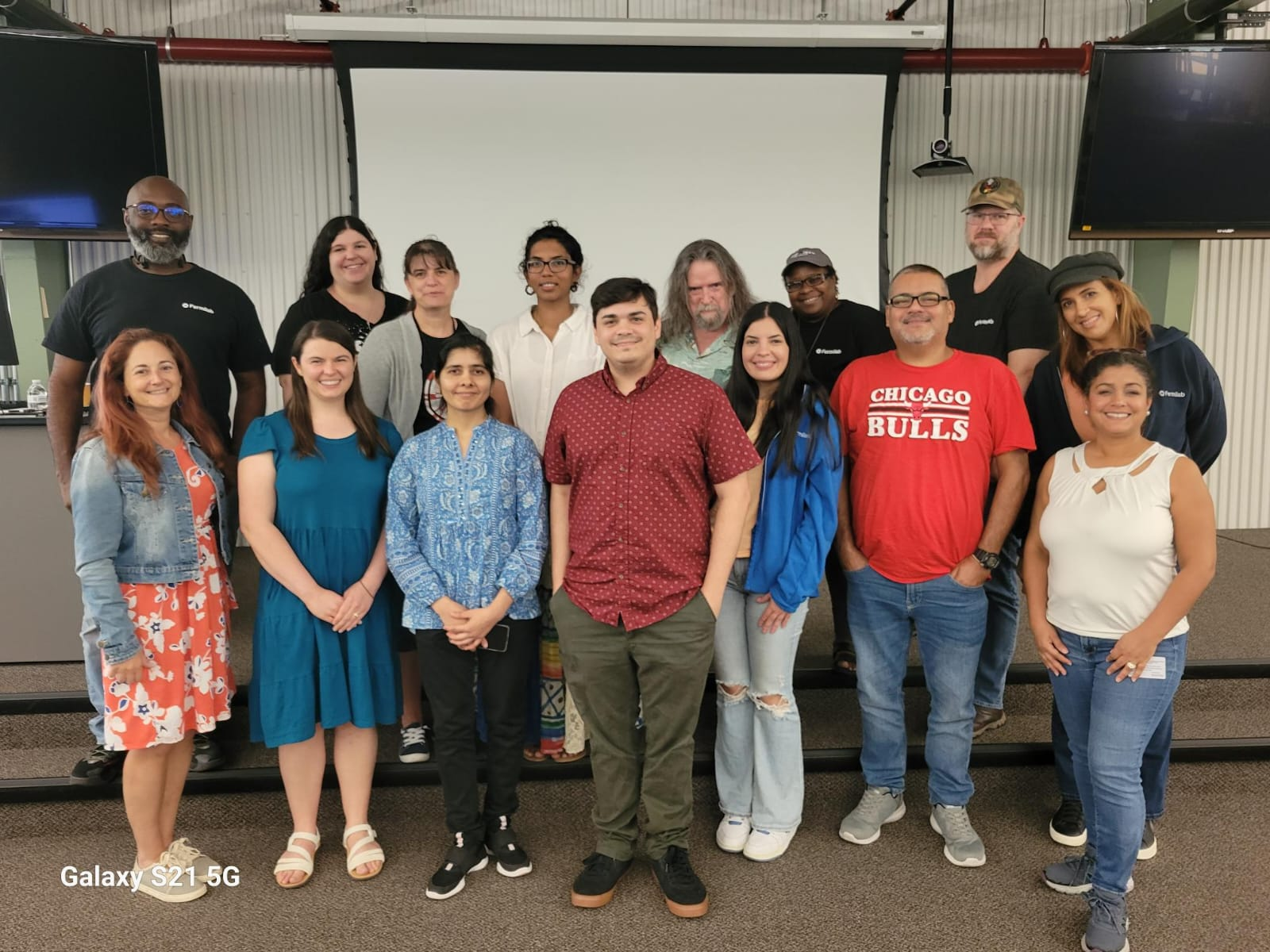
Coding Camp participants at Fermilab in July 2024. Credit: Sudhir Malik, University of Puerto Rico Mayaguez
Getting Down to Coding Business
The Coding Camp initiative grew out of earlier outreach and coding projects pursued by Malik and LaMee through QuarkNet, an NSF and Department of Energy (DOE)-funded program that connects high school physics teachers with particle physicists and has a quarter-century legacy of bringing real research into classrooms.
With IRIS-HEP funding, the Coding Camp effort grew from post-COVID remote sessions into approximately three-day workshops. The workshops are often held at universities that have faculty researchers affiliated with IRIS-HEP and/or the Compact Muon Solenoid (CMS), a detector experiment at the Large Hadron Collider, the world’s biggest machine and most powerful particle accelerator.
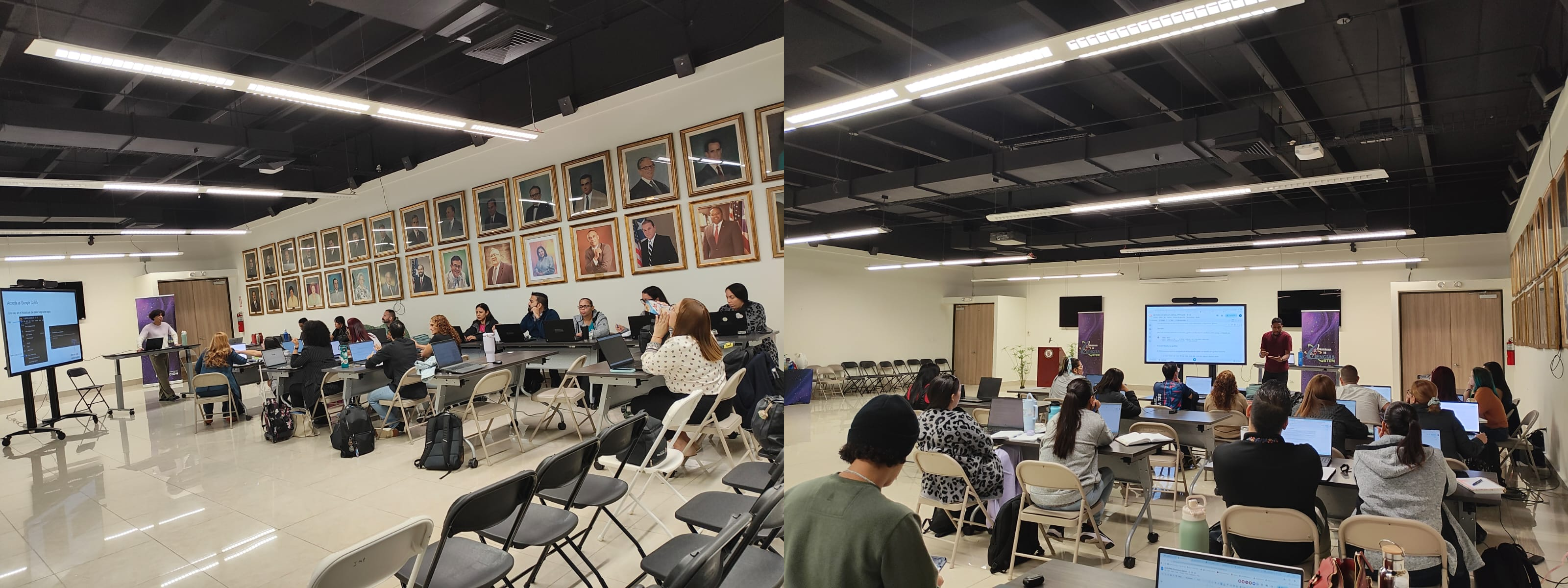
The camps come in three basic varieties: online only, in-person, and special in-person sessions where teachers are trained as coding fellows that can host their own Coding Camps. For the last three summers—now going on four—Coding Camps have welcomed high school teachers to in-person workshops at universities including the University of Alabama in Tuscaloosa; the University of Nebraska–Lincoln; Rice University in Houston, Texas; Siena College in New York; the aforementioned University of Puerto Rico at Mayagüez; and the University of Washington in Seattle. Camps have also been held at the Fermi National Accelerator Laboratory (Fermilab) outside Chicago, the site of predecessor workshops to IRIS-HEP Coding Camps.
In typical sessions, around a couple dozen teachers participate and receive a stipend to support their attendance. The participants get to train and do coding with Python, a versatile and popular computer programming language used in high-energy physics. During sessions, teachers work with genuine data in applying physics principles to reduce or explain observations in investigations, as well as examine simulated and experimental data. Just as professional physicists do, the teachers create, organize, and interpret data plots, iterating towards identifying patterns within the data and considering the causes of those patterns. The teachers proceed to making claims based on evidence and provide explanations for these claims, while also critically identifying data limitations.
To cap off Coding Camp, teachers are tasked with creating projects that will advance their students’ coding chops and overall scientific aptitude using activities and ideas from the workshop. For Danelix Cordero, a high school teacher who teaches physics, astronomy, and robotics at CROEM (Residential Center of Educative Opportunities of Mayagüez) in Puerto Rico, this classroom-directed effort led her to integrate coding work across her syllabi. “My students have this opportunity to make first contact with programming on Python,” she says.
Projects have included mathematics- and analysis-centered efforts with particle physics data. Cordero’s students also recently crafted an emotional facial recognition program using Python-based machine learning for helping astronauts through NASA HUNCH (High Schools United with NASA to Create Hardware), a workforce development initiative that presents students with authentic challenges from ongoing missions.
For Tracie Schroeder, a teacher at Council Grove High School in rural eastern-central Kansas, Coding Camp equipped her to introduce her students to Google Colab notebooks, which are web-based documents that meld executable code with images, HTML (markup language that structures websites), and more. She has utilized this approach for her advanced physics class in engineering, where students have, for example, built a program for analyzing where 3D printed bridges are likeliest to break. The classroom coding approach has also been eagerly adopted by Schroeder’s freshman physics class and even a 7th grade computer science course she has started teaching.
“I’m just so impressed with my 7th graders. They’re blowing me away with how quiet my classroom gets . . . this isn’t usually a quiet group!” says Schroeder. “They’re very invested in fixing inevitable errors in code, and I think that problem-solving part is really important.”
Inculcating students as early as middle school in coding will pay scientific dividends in the years ahead. “A fundamental goal of ours with Coding Camps and other outreach efforts is to demystify coding,” says LaMee. “To have teachers, and subsequently their students, be able to do things with authentic scientific computing tools, the benefit down the road is that if the student encounters code, they’ll not immediately have a wall go like, ‘Oh, I heard that’s tough.’ They’ll instead feel ready to take it on.”
Professional Development Opportunities
Overall, Coding Camp attendees have overwhelmingly reported their experiences as highly professionally valuable—and a good time to boot. For example, Cordero has advanced her skills to the point that she’s become a Teaching Fellow in Puerto Rico, hosting Coding Camp workshops taught in Spanish on the island and elsewhere. In 2025 alone, 88 teachers across Puerto Rico came to Cordero’s workshops, helping to spread coding knowledge and passion to scores of classrooms. “We have reached teachers all over Puerto Rico and shown them programming that their students can use in so many ways,” says Cordero.
Coding Camp efforts have gained so much traction that the Puerto Rico Department of Education has started paying some teachers to attend the workshops. “Our work is valued by the local state education department because they want more machine learning and Python workshops to train teachers,” says Malik.
Back on the mainland, Schroeder likewise excelled as a Coding Camp participant and was recruited as a Teacher Fellow to lead workshops around the country for the IRIS-HEP Coding initiative. Schroeder says she has enjoyed getting to network with other physics teachers, helping enhance her Coding Camp takeaways even more. “There’s a lot of levels of awesome with our workshops,” Schroeder says. “We get to talk about ‘hey, here’s what I’m doing in my classroom, here’s what’s working.’ It’s been really fun and interesting.”
For Malik, LaMee, and other leaders of the Coding Camp workshop initiative, this feedback from participants has been extremely rewarding and helped tailor the camp’s offerings for maximum results.
“Teachers have told us they love to get trained by people who do research in particle physics, rather than just learning Python as a course,” says Malik. “The research that we do is at the horizon of human knowledge, and we get to bring that perspective into programming.”