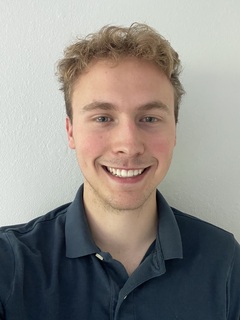
IRIS-HEP Fellow: Cody Tanner
Fellowship dates: Jul – Sep, 2025
Jun – Sep, 2026
Home Institution: University of Washington
Project: Differentiable Modeling of Systematic Uncertainties in ATLAS Object Corrections (2025)
Modern ATLAS analyses depend on object corrections that are currently implemented through non-differentiable procedures like histogram lookups and conditional logic, limiting their integration into gradient-based pipelines. This project proposes a neural network model that replicates ATLAS object corrections, including systematic uncertainties, for small-R jets in a differentiable and computationally efficient form. Starting from an existing baseline trained on the JZ2 dataset, the model will be refined through architectural tuning, loss reweighting, and incorporation of per-object uncertainties to approach sub-percent residuals in jet kinematics. A final case study will use the model to reconstruct Z→jj peaks, evaluating the physics impact of improved corrections and uncertainty modeling. This work provides a foundation for embedding fast, uncertainty-aware corrections directly into end-to-end ATLAS workflows.
More information: My project proposal
Mentors:
-
Gordon Watts (University of Washington)
Project: Differentiable Modeling of Systematic Uncertainties in ATLAS Object Corrections (2026)
“Modern ATLAS analyses of rare processes such as Z → qq̄ depend on both precise calibration of reconstructed objects and machine-learning classifiers, but the two are typically decoupled by non-differentiable selection steps that break gradient flow. This project proposes a fully differentiable analysis pipeline connecting a systematically calibrated jet-correction network to a downstream signal-background classifier. The central technical contribution is replacing the discrete arg max jet-pair selection with a smooth alternative, such as soft attention or a Gumbel-softmax relaxation, restoring end-to-end differentiability across the full chain. With gradient flow restored, the classification stage will be trained on frozen, physics-validated calibrated inputs, and the resulting pipeline will be evaluated under variations of the leading systematic uncertainties to quantify the robustness gained relative to an uncalibrated baseline. A final study will report performance in terms of signal significance and a cross-section measurement, with results documented in a public code release and a draft publication. This work demonstrates a path toward embedding calibration-aware, systematics-robust machine learning directly into end-to-end ATLAS analysis workflows.”
More information: My project proposal
Mentors:
-
Gordon Watts (University of Washington)
Current Status
Contact me: